How much should freelancers set aside for taxes in Canada?
A simple rule of thumb, a worked example for 2026, and roughly how much to save at different income levels. The goal is to always know what is safe to spend.
Set aside about 25 to 30 percent
Of everything you invoice, park roughly a quarter to a third for tax. Lower earners land nearer 20 percent, higher earners nearer 30 percent or more. Saving a little extra is safer than coming up short in April.
When you work for an employer, tax and CPP come off every paycheque before you see the money. As a freelancer nobody does that for you. The full amount lands in your account, and part of it is really the CRA's. Set that part aside as you earn and tax season stops being a surprise.
Why freelancers owe more than employees
Two things make the self-employed bill larger than people expect:
- No withholding. Your clients pay the full invoice. The tax is not held back, so it is on you to save it.
- You pay both halves of CPP. Employees split the Canada Pension Plan contribution with their employer. When you are self-employed you pay both sides, which is 11.9 percent on your net income up to the annual limit in 2026.
Income tax itself works the same as for anyone else. It is progressive, so only the dollars inside each bracket are taxed at that bracket's rate, and a basic personal amount is tax free.
What your set-aside is made of
For most freelancers the amount to save is two things added together:
- Income tax, federal plus your province.
- CPP, both halves, on your net self-employment income.
GST/HST is not part of this percentage. If you are registered, the tax you add to invoices is money you collect for the CRA and hand back later. Keep it separate from both your income and your income-tax savings. More on the registration point below.
A worked example: Ontario, 60,000 dollars, 2026
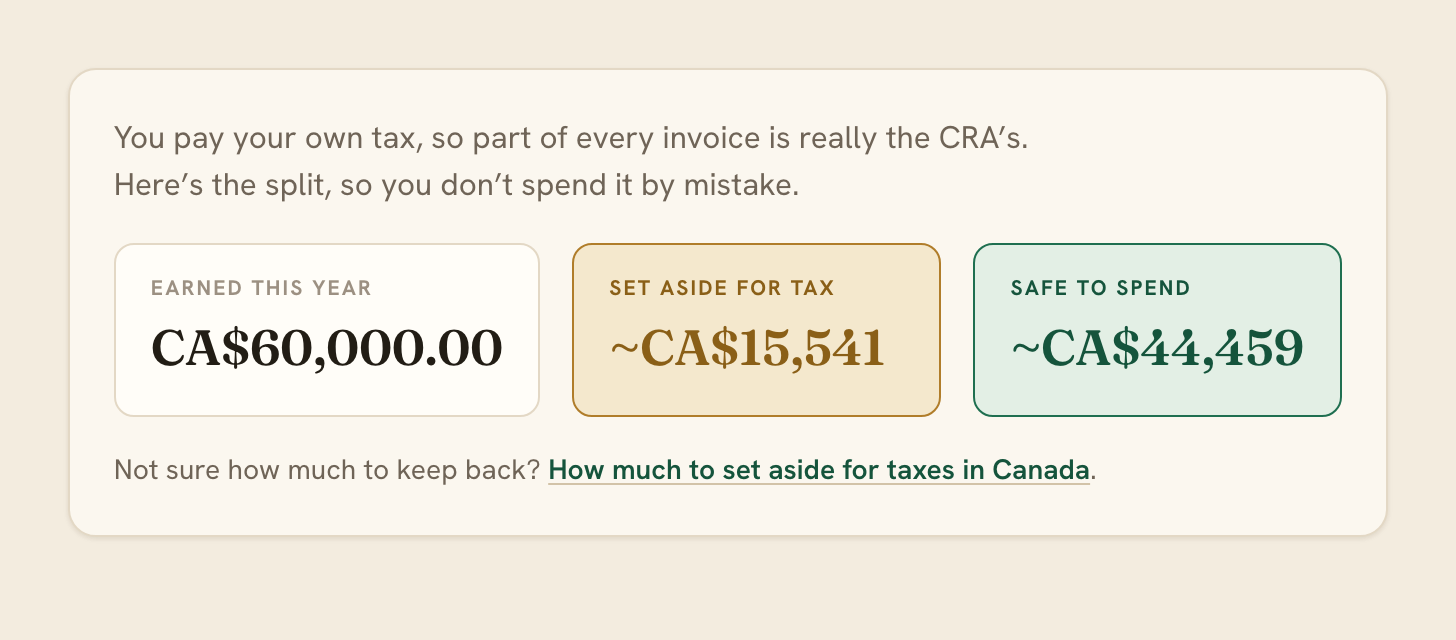
Say you are a sole proprietor in Ontario who invoiced 60,000 dollars in 2026, with no business expenses to keep the math clean. Here is roughly how it breaks down.
About 15,500 dollars
Income tax about 8,800 dollars (federal and Ontario combined) plus CPP about 6,700 dollars. That is close to 26 percent of what you earned.
Split across the year, that is a bit under 1,300 dollars a month moved into a separate savings spot. Do that as the income arrives and the year-end number is already covered.
Roughly how much to save by income
A quick sense of the range for an Ontario sole proprietor in 2026, before expenses. Higher income means a higher percentage, because more of it falls in higher brackets.
| You invoice | Set aside about | Which is roughly |
|---|---|---|
| 30,000 | 6,000 | 20 percent |
| 60,000 | 15,500 | 26 percent |
| 100,000 | 30,000 | 30 percent |
When you also need to charge GST/HST
Separate from income tax, once your revenue passes 30,000 dollars over four consecutive quarters, you generally have to register for a GST/HST number and start charging it. That charged tax is not yours to keep. You collect it and remit it to the CRA, so track it apart from everything above. For the full picture, see the guide on GST/HST and the $30,000 threshold. The app also flags when you are getting close.
How to make your set-aside automatic
The hard part is not the percentage. It is remembering to move the money every time you get paid, and keeping the number honest as your income grows through the year. That is what Logbill does. You track your time, it becomes an invoice, and it shows what to set aside for tax as you earn, so you always know what is safe to spend.
See your set-aside in the appFree while in beta. Runs in your browser, nothing to install.
Common questions
What percent of income should a freelancer save for taxes in Canada?
A common rule of thumb is 25 to 30 percent of what you earn. Lower earners land nearer 20 percent and higher earners nearer 30 percent or more, because income tax is progressive and you also pay both halves of CPP.
Do freelancers pay tax quarterly in Canada?
Many self-employed people pay once a year, but the CRA can require quarterly instalments once your net tax owing passes about 3,000 dollars in the current year and one of the two prior years. If that applies, the CRA sends instalment reminders.
Is GST/HST included in the amount I set aside for tax?
No. GST/HST is separate. If you are registered, the tax you charge on invoices is money you collect and remit to the CRA, on top of your income tax and CPP. Registration is generally required once revenue passes 30,000 dollars.
What if I get paid in US dollars?
You still report income in Canadian dollars. Convert each payment to CAD, then set aside on the converted amount. A tool that tracks the rate as you invoice keeps this from becoming a year-end scramble.