How much should freelancers set aside for taxes in the US?
A simple rule of thumb, a worked example for 2026, and roughly how much to save at different income levels. The goal is to always know what is safe to spend, and to be ready for each quarterly payment.
Set aside about 25 to 30 percent
Of everything you invoice, park roughly a quarter to a third for tax. In a state with no income tax it lands nearer 20 percent, and in a high-tax state it climbs past 30 percent. Saving a little extra is safer than coming up short at a quarterly deadline.
When you work for an employer, tax is withheld from every paycheck before you see the money. As a freelancer or 1099 contractor nobody does that for you. The full amount lands in your account, and part of it is really the IRS's. Set that part aside as you earn and each quarterly deadline stops being a scramble.
Why freelancers owe more than employees
Two things make the self-employed bill larger than people expect:
- No withholding. Your clients pay the full invoice. Nothing is held back, so it is on you to save the tax and pay it yourself.
- You pay both halves of self-employment tax. Employees split Social Security and Medicare with their employer. On your own you pay both sides, which is 15.3 percent on most of your net earnings. Half of it is deductible against income tax, which softens the blow a little.
Federal income tax then works the same as for anyone else. It is progressive, so only the dollars inside each bracket are taxed at that bracket's rate, and a standard deduction is tax free.
What your set-aside is made of
For most freelancers the amount to save is three things added together:
- Self-employment tax, 15.3 percent, made of 12.4 percent Social Security up to the annual wage base (184,500 dollars in 2026) plus 2.9 percent Medicare with no cap, charged on 92.35 percent of your net earnings.
- Federal income tax, on your net income after the standard deduction, the deductible half of self-employment tax, and the QBI deduction below.
- State income tax, if your state has one.
Many freelancers can also deduct 20 percent of their qualified business income, the Section 199A or QBI deduction, which lowers the federal income-tax piece. The worked example below already includes it.
A worked example: single filer, 60,000 dollars, 2026
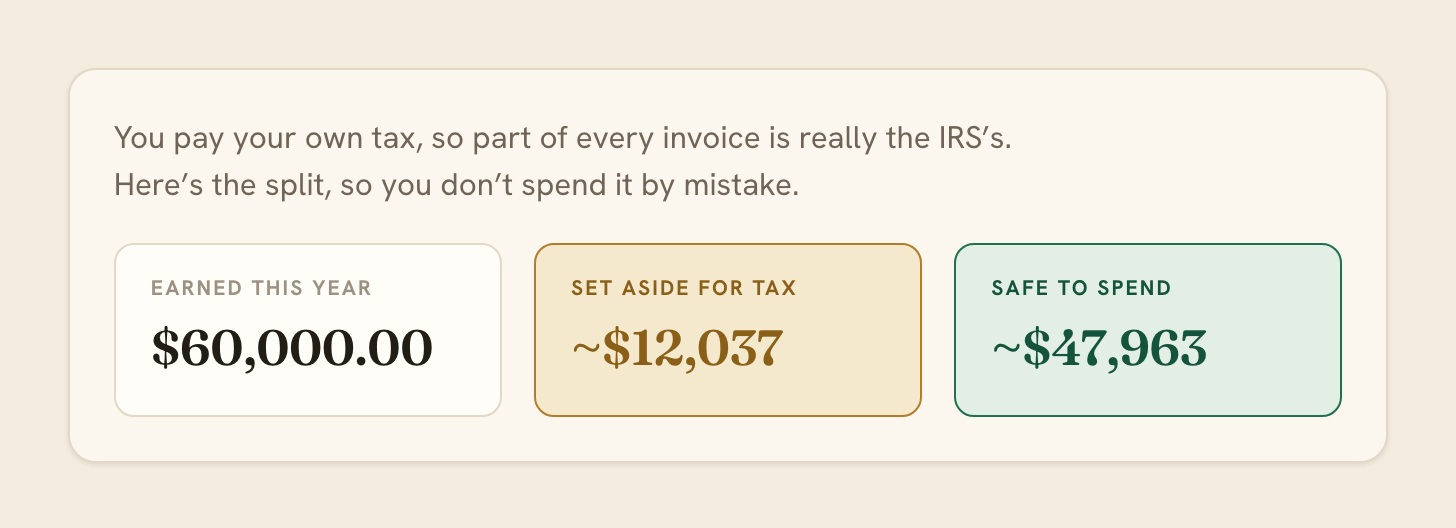
Say you are a sole proprietor filing single who invoiced 60,000 dollars in 2026, with no business expenses to keep the math clean, in a state with no income tax. Here is roughly how it breaks down.
About 12,000 dollars
Self-employment tax about 8,500 dollars plus federal income tax about 3,600 dollars. That is close to 20 percent of what you earned, before any state tax.
Split across the year, that is about 1,000 dollars a month moved into a separate savings spot, ready for each quarterly payment. Do that as the income arrives and every deadline is already covered.
Your state moves the number a lot
The example above is federal tax plus self-employment tax only. Add your state on top:
| 60,000 dollars, single | Set aside about | Which is roughly |
|---|---|---|
| No-income-tax state (TX, FL, WA) | 12,000 | 20 percent |
| New York, mid bracket | 15,500 | 26 percent |
| California, 9.3 percent | 17,600 | 29 percent |
Roughly how much to save by income
A quick sense of the range for a single filer in a no-income-tax state in 2026, before expenses and before any state tax. Higher income means a higher percentage, because more of it falls in higher brackets.
| You invoice | Set aside about | Which is roughly |
|---|---|---|
| 30,000 | 5,200 | 17 percent |
| 60,000 | 12,000 | 20 percent |
| 100,000 | 22,400 | 22 percent |
Pay it in quarters, not all at once
The IRS wants tax paid as you earn, through four estimated payments a year, due around April 15, June 15, September 15, and January 15. You generally need to make them if you expect to owe 1,000 dollars or more when you file.
To avoid an underpayment penalty, the safe-harbor rule says pay at least 90 percent of this year's tax, or 100 percent of last year's tax, whichever is smaller. If your prior-year income was over 150,000 dollars, that second figure is 110 percent. This is exactly why setting money aside as you earn matters: when a quarterly date arrives, the payment is already sitting there.
Working in Canada instead? See how much to set aside for taxes in Canada, where the mix is income tax plus both halves of CPP.
How to make your set-aside automatic
The hard part is not the percentage. It is remembering to move the money every time you get paid, keeping the number honest as your income grows, and having it ready when a quarterly payment is due. That is what Logbill does. You track your time, it becomes an invoice, and it shows what to set aside for tax as you earn, so you always know what is safe to spend.
See your set-aside in the appFree while in beta. Runs in your browser, nothing to install.
Common questions
What percent of income should a freelancer set aside for taxes in the US?
A common rule of thumb is 25 to 30 percent of what you earn. It lands nearer 20 percent in a state with no income tax and climbs past 30 percent in a high-tax state, because you pay self-employment tax of 15.3 percent on top of progressive federal income tax and any state tax.
Do freelancers have to pay taxes quarterly in the US?
Usually yes. The IRS expects estimated tax payments four times a year, around April 15, June 15, September 15, and January 15, if you expect to owe 1,000 dollars or more when you file. Setting money aside as you earn is what makes each quarterly payment painless.
What is self-employment tax?
It is Social Security and Medicare for the self-employed: 15.3 percent, made of 12.4 percent Social Security up to the annual wage base and 2.9 percent Medicare with no cap, charged on 92.35 percent of your net earnings. An employee splits this with an employer. On your own you pay both halves, though half of it is deductible against your income tax.
Does my state change how much I set aside?
A lot. Nine states have no income tax, so your set-aside is just federal tax plus self-employment tax. Others range from a few percent to over ten percent, added on top of everything else. Use your own state rate rather than a national average.